Laccase for Bioremediation and Micropollutant Oxidation
Application-led guidance on using Laccase (benzenediol:oxygen oxidoreductase) for oxidative treatment concepts targeting dyes, phenols, endocrine-active compounds, and persistent organic contaminants.
Laccase for bioremediation and micropollutant oxidation
Persistent organic contaminants often survive conventional treatment because they are dilute, structurally diverse, and chemically stable. Laccase (benzenediol:oxygen oxidoreductase) gives treatment developers a controlled oxidative tool for changing that chemistry using molecular oxygen as the terminal oxidant.
In practical terms, laccase can help transform oxidizable compounds into structures that are easier to adsorb, precipitate, filter, or biologically polish. For industrial wastewater teams, environmental technology developers, and research groups, the value is not a single universal removal claim. It is a tunable oxidation step that can be matched to the matrix, contaminant class, and downstream separation strategy.
Where laccase fits
Laccase is most relevant where the target contaminants include electron-rich aromatic structures or phenolic functionality. Common development areas include:
- Synthetic dye oxidation in textile and dyehouse effluents
- Phenolic compound transformation in industrial wastewater and plant-derived process streams
- Endocrine-active compound oxidation in advanced treatment concepts
- Aromatic amine and substituted aromatic treatment where oxidative coupling is feasible
- Pulp, paper, and lignocellulosic effluents containing colored or phenolic fractions
- Landfill leachate and mixed organic matrices as part of polishing-stage research
- Mediator-assisted oxidation studies for compounds that are not direct laccase substrates
The strongest programs start with matrix-specific screening. Salt load, surfactants, dissolved organic matter, color bodies, metals, residual oxidants, and pH can all shift the result.
Mechanism: oxygen-driven radical chemistry
Laccase contains copper-active sites that accept electrons from suitable organic substrates and transfer them to oxygen. The enzyme oxidizes phenols, aminophenols, aromatic amines, and related structures to reactive radical intermediates. Those intermediates can follow several useful pathways:
- Polymerization or coupling, increasing apparent molecular size and enabling separation
- Structural disruption of chromophores, reducing visible color in selected dye systems
- Functional group modification, changing reactivity, hydrophobicity, or adsorption behavior
- Preparation for downstream treatment, including activated carbon, membrane separation, coagulation, or biological polishing
For some micropollutants, direct oxidation may be limited. In those cases, a mediator can shuttle oxidative potential from laccase to less accessible substrates. Mediator selection is application-critical because it affects cost, compatibility, by-product profile, and regulatory acceptability.

Practical operating window
Laccase is attractive because it can operate in mild, water-based treatment concepts without a peroxide feed. Most development work evaluates:
- Mildly acidic to near-neutral process conditions, depending on substrate and enzyme source
- Ambient to moderate process temperatures compatible with many wastewater trains
- Dissolved oxygen availability, mixing, and contact design
- Residence time versus removal target, especially in continuous treatment concepts
- Enzyme reuse or immobilization, where economics require retention or repeated exposure
- Compatibility with the real matrix, not only clean surrogate solutions
Because contaminant mixtures are rarely clean, the best technical question is not “does laccase oxidize this molecule?” It is “does laccase create a measurable treatment advantage in this specific stream and treatment train?”
Treatment concepts we support
Direct enzymatic oxidation
For phenolic and dye-rich streams, laccase may act directly on oxidizable components. This is typically the simplest concept to screen and can be valuable where the objective is color reduction, phenolic load modification, or improved separability.
Mediator-enabled oxidation
For less accessible micropollutants, mediator systems may expand the oxidation range. This route can be powerful, but it requires careful review of mediator cost, persistence, toxicity, downstream fate, and procurement practicality.
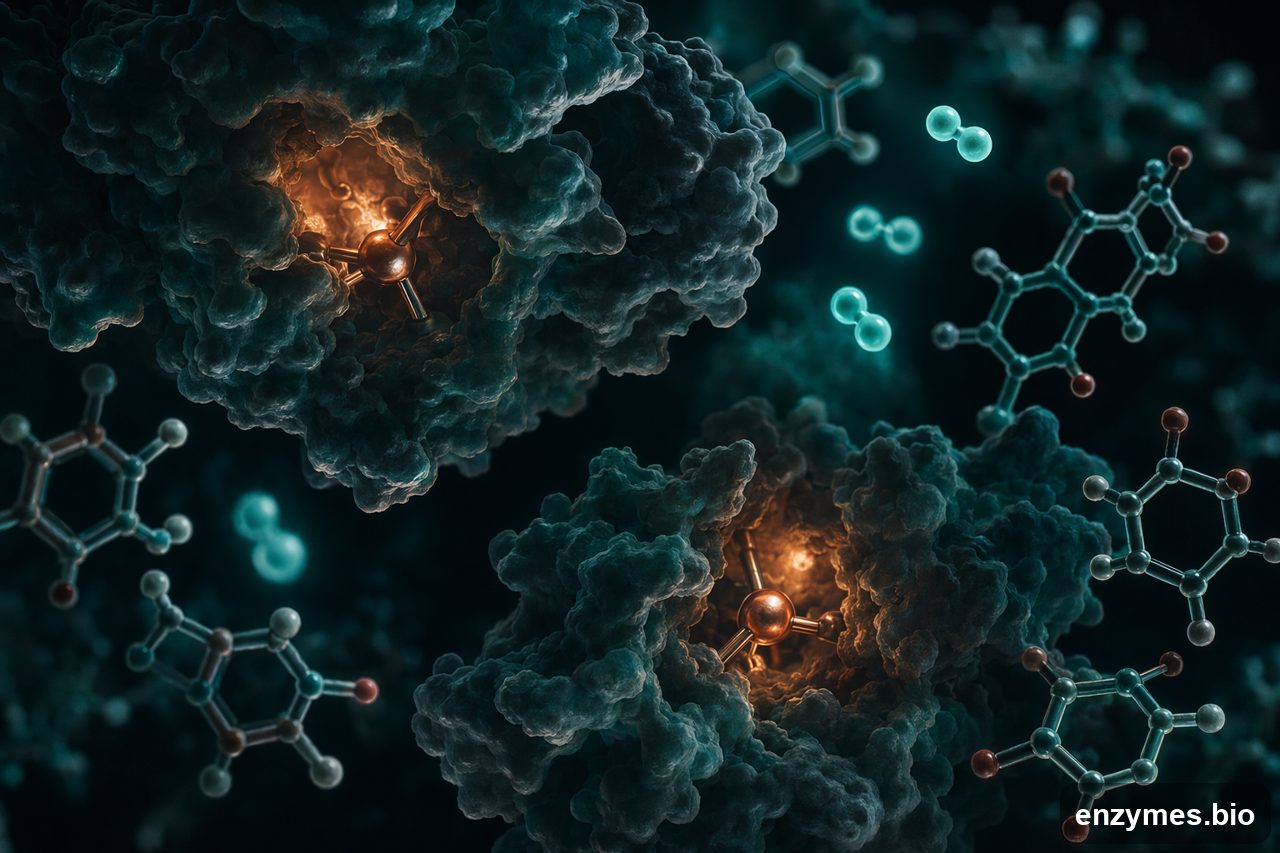
Immobilized or retained enzyme formats
Where the process requires repeated use, lower enzyme loss, or defined contact zones, laccase can be evaluated in immobilized, coated, membrane-associated, or carrier-bound concepts. These formats can improve handling and process control, but mass transfer and fouling must be tested with the real wastewater.
Hybrid polishing trains
Laccase is often most credible as part of a hybrid system rather than a stand-alone cure. Pairing enzymatic oxidation with adsorption, filtration, coagulation, membrane treatment, or biological polishing can convert chemical transformation into measurable removal.
Substrate and matrix considerations
Before specifying laccase, define the chemistry of the stream. The following factors strongly influence feasibility:
- Target compound class and whether phenolic, aniline-like, or other electron-rich motifs are present
- Color bodies, lignin-derived compounds, humics, tannins, or natural phenolics that may compete for oxidation
- Surfactants, salts, chelators, preservatives, or residual biocides that can interfere with enzyme performance
- Suspended solids and colloids that affect contact, fouling, or separation
- Desired endpoint: decolorization, toxicity reduction, target compound depletion, improved filtration, or discharge compliance support
- Downstream fate of oxidized products and any mediator-derived by-products
A successful laccase program measures both disappearance of the parent pollutant and the behavior of transformation products. In environmental applications, “oxidized” is not automatically “solved.”
Procurement and scale-up questions
For buying teams and process developers, laccase selection should be tied to the job it must perform. Useful specification discussions include:
- Liquid or dry supply preference
- Batch treatment, side-stream treatment, or continuous contactor concept
- Expected storage conditions and handling limits
- Compatibility with existing dosing, mixing, and control systems
- Need for immobilization trials or carrier compatibility
- Trial volume, pilot schedule, and documentation requirements
- Whether the application requires food, technical, or environmental-use positioning
We keep the discussion focused on process fit, formulation practicality, and reliable supply. Detailed assay methods and internal activity standardization remain supplier-confidential, but we can align on performance testing that reflects your treatment objective.
Why Oxyloom for this application
Oxyloom approaches laccase as an industrial oxidation tool, not a generic catalog ingredient. For bioremediation and micropollutant oxidation projects, we help teams frame the right screening path:
- Identify whether the target chemistry is a plausible laccase substrate
- Separate direct oxidation opportunities from mediator-dependent concepts
- Evaluate real-matrix inhibitors before pilot commitments
- Choose a supply format that fits handling, dosing, and storage needs
- Support procurement with clear application context and quote-ready details
If your stream contains dyes, phenols, endocrine-active compounds, or persistent aromatic contaminants, laccase may offer a lower-chemical oxidative route worth testing.
Request a quote or technical fit review
Share the wastewater type, target compounds, current treatment train, desired endpoint, and preferred supply format. Our team will review the application and respond with pricing guidance or the next technical questions.

More from Oxyloom
Laccase for Biosensors and Functional Materials | Oxyloom
Laccase for Cosmetic and Personal Care Formulation Research | Oxyloom
Laccase for Food Processing & Ingredient Modification | Oxyloom
Laccase for Green Oxidation Chemistry | Oxyloom
Laccase for Lignin-Based Biomaterials | Oxyloom
Laccase for Paper Mill Effluent Treatment | Oxyloom
Request pricing & specs
Tell us your application and volume — we reply with pricing and lead time.